
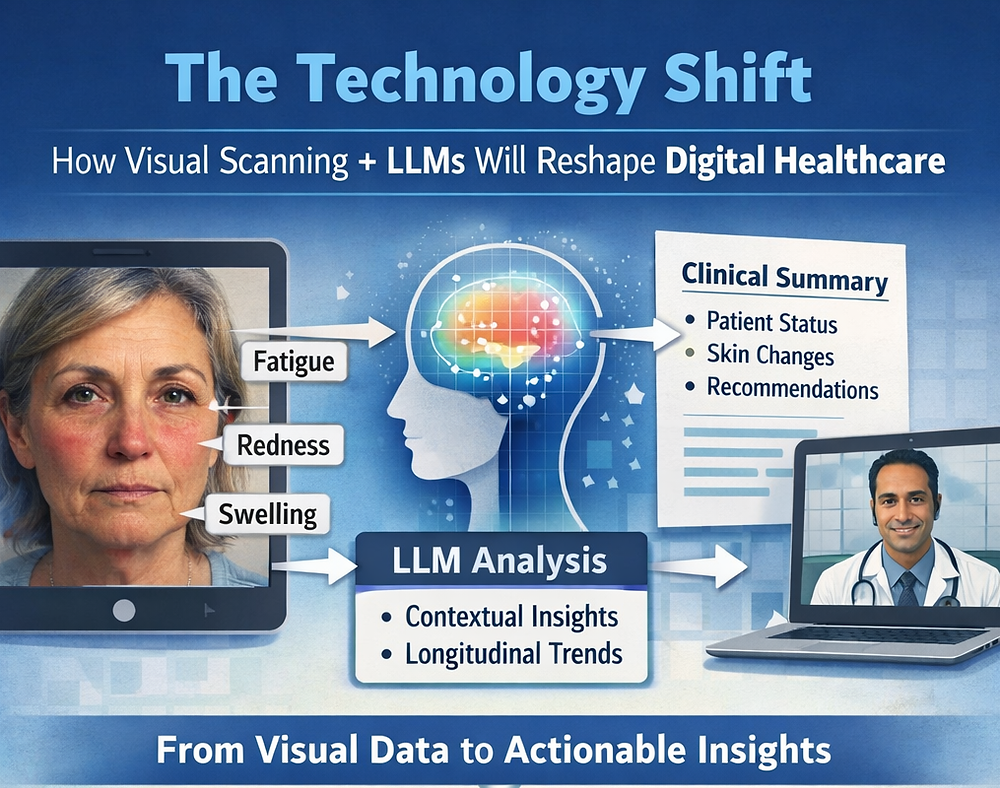
Healthcare is swimming in visual data, but often doesn’t know how to make use of it all.
Just looking at someone’s face can tell you so much:
- skin tone changes
- swelling
- asymmetry
- inflammation
- fatigue and stress signals
Doctors and nurses are trained to pick up on these signals, but in digital visits, a lot of that detail slips through the cracks:
- Video quality varies
- Visits are rushed
- nothing is stored in a structured way
The problem hasn’t really been with cameras. It’s making sense of what we see, and putting it in context.
Why visual scanning alone wasn’t enough
Old-school computer vision systems struggled for a few reasons:
- signals are subtle, not binary
- context matters
- interpretation depends on history, not snapshots
A single snapshot, without any backstory, just adds to the confusion.
That’s why the first wave of visual health tech didn’t really take off.
The role of LLMs changes the equation
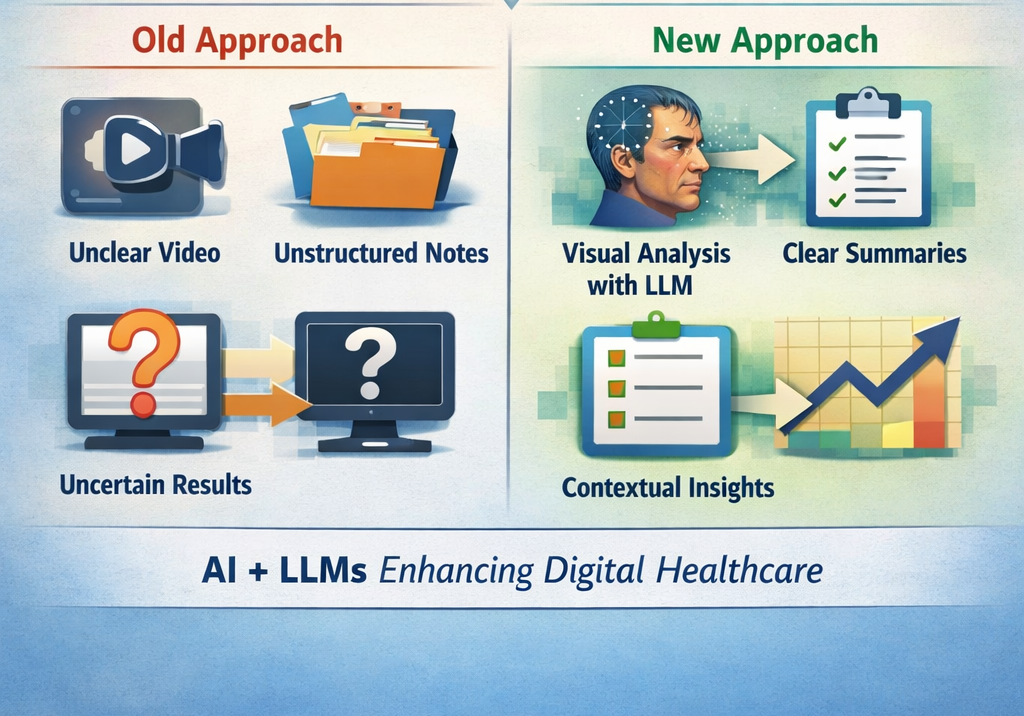
Large Language Models (LLMs) shake things up by adding:
- contextual reasoning
- pattern interpretation across time
- structured summarization of complex signals
When you put these LLMs together with visual tech, here’s what starts to happen:
- interpret visual outputs conservatively
- translate signals into clinician-readable summaries
- connect visual cues with longitudinal history
- avoid over-assertive conclusions
That doesn’t mean turning diagnoses over to a computer.
It means giving clinicians a much better context, explained clearly, and without the hype.
Turning images into real clinical insights
The big breakthrough isn’t just about spotting conditions in a photo.
It’s converting:
- Unstructured visual datainto
- Structured, cautious, longitudinal signals
These signals help clinicians know what to pay attention to, ask sharper questions, and actually see how things change from visit to visit.
LLMs are the glue that connects all this raw image data to the way doctors actually work.
Why this is finally possible (and urgent)
Three things have come together lately:
- Camera quality is good enough
- LLMs can reason and summarize conservatively
- Telehealth platforms need differentiation beyond video
Put all this together, and you get something new: tools that add a layer of visual intelligence to digital care.
This isn’t about flashy apps or mysterious black-box AI. It’s about building tools that actually support clinicians, in the way real care teams work.
The long-term impact
Over time, systems like this can:
- reduce unnecessary visits
- surface issues earlier
- improve chronic care follow-up
- lower system-wide costs
Most importantly, they care teams focus where it matters most: on patients who need them, when they need them.
That’s the real game changer.
We’re already building and testing this with telehealth partners. If you want to dive in, try a pilot, or just swap ideas, reach out—we’d love to connect.