
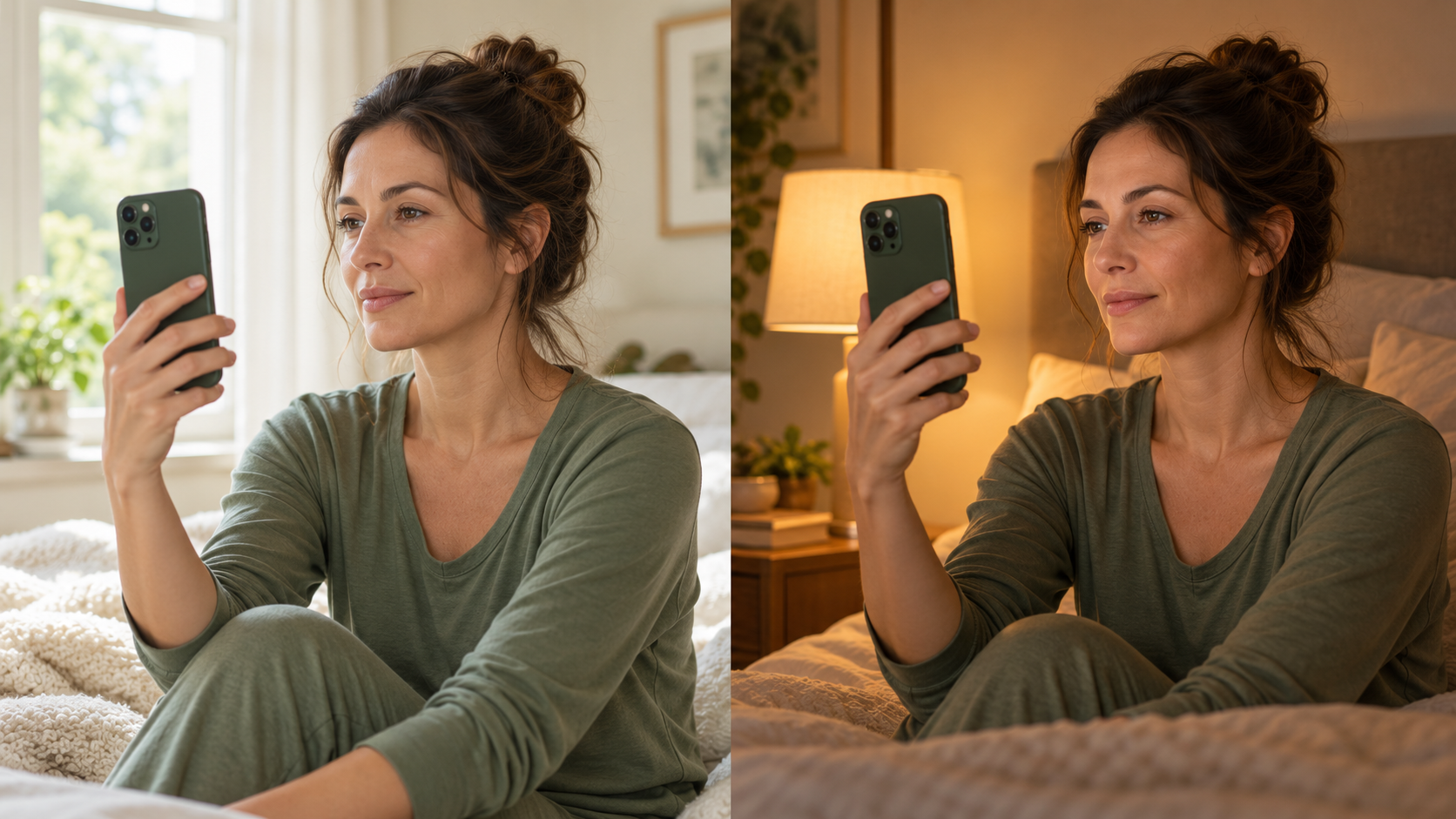
Morning and evening facial observations could provide an optional record of what patients notice before a sleep-clinic appointment. Collected alongside a sleep diary and the patient's own notes, they may help organise information for discussion. They do not measure sleep quality or diagnose a sleep disorder.
FaceEcho provides guided facial scans and downloadable reports that patients can choose to share with a clinician. This article explores how a sleep clinic could use that approach alongside its existing sleep diaries, with the workflow adapted to the clinic's requirements.
Where does FaceEcho fit into preparation for a sleep appointment?
FaceEcho already supports comparisons using guided facial scans, answers to relevant questions and logged information. As How FaceEcho Works explains, reports can be saved, compared over time and downloaded as a PDF. The FaceEcho health experience brings visible observations together with symptoms, timing and health history in one report.
For an interested sleep-clinic partner, we would adapt that existing capability to bring together morning and evening observations and sleep-diary information over a set period, such as two weeks. The underlying comparison functionality exists today. The specific sleep-clinic workflow would be configured with a participating clinic, and its usefulness in that setting would need to be evaluated.
Each part contributes something different:
- Guided scans document facial observations under the conditions in which they were captured.
- Sleep diaries record the patient's sleep experiences and habits.
- Patient answers and notes provide context, such as how rested they feel or what was unusual about the day.
- The clinician interprets the information and decides the next steps.
Why is this information often missing from a sleep consultation?
A sleep consultation is a snapshot of a much longer experience. The clinician may see a patient at 11 a.m. on a Thursday, in clinic lighting, after a journey. That shows little of what the patient noticed at 7 a.m. on Monday or before bed on Wednesday, and most of that detail has to come from memory.
Sleep diaries already help with the overnight part. The American Academy of Sleep Medicine's sleep diary is designed to be completed daily, typically over two weeks. It records bedtimes, night waking, wake times, naps, and the timing of caffeine, alcohol, exercise and medication.
A diary documents sleep-related experiences and habits. It does not record what the patient noticed about their appearance, and the photos patients do take are usually scattered across a camera roll, in different rooms and light. A consistent morning and evening record is intended to sit alongside the diary, not replace it.
What does the research show about faces and sleep loss?
There is scientific interest in how sleep loss affects appearance, but the evidence needs context. In a 2013 study published in Sleep, “Cues of Fatigue: Effects of Sleep Deprivation on Facial Appearance”, researchers photographed 10 participants after normal sleep and again after 31 hours without sleep. Forty observers then rated the photographs. Faces after sleep deprivation were rated as having more hanging eyelids, redder and more swollen eyes, darker circles under the eyes, paler skin and droopier corners of the mouth.
The study shows how other people perceive faces after extreme sleep deprivation. It does not show that facial appearance can measure an individual's sleep quality or identify a sleep disorder. It does not validate FaceEcho or establish any clinical benefit for the workflow described here.
A person who looks tired has not necessarily slept poorly, and someone who looks rested may still have a sleep problem. Whether a morning and evening record adds anything useful to a consultation is a question to test, not to assume.
What would a morning and evening record include?
The record would cover the same period as the clinic's usual sleep diary and include four elements:
- A morning observation, captured shortly after waking, before washing the face or applying skincare or makeup.
- An evening observation, captured before bed in the same room, light and camera position.
- Sleep diary entries in the clinic's existing diary. There is no need for a separate, competing diary.
- A few short questions: how rested the patient feels, whether anything unusual happened and what they want to discuss.
The patient's own words carry much of the value. A note such as “slept around four hours after a night shift” or “woke three times and struggled to get back to sleep” gives the clinician context that a photograph cannot. These notes do not show that sleep caused any visible difference.
How should patients capture consistent observations?
Lighting, camera distance, angle, expression and even the phone used can change how a face looks. A morning photograph by a sunny window and an evening photograph under a warm lamp may differ because of the light rather than the person. How FaceEcho Works notes that capture conditions affect appearance and recommends similar lighting and positioning when comparing scans.
Dermatology has long faced the same problem. The International Skin Imaging Collaboration's proposed technical guidelines for acquiring clinical images of skin conditions set out recommendations on lighting, background, field of view, orientation and focus so that images can be compared more reliably. A home routine needs only the basics:
- Use the same room and artificial light source morning and evening.
- Follow the on-screen guidance for distance, angle and position every time.
- Capture in a consistent state, such as before washing the face.
- Note anything that could affect appearance, such as allergies, a cold, crying, alcohol or a new skincare product.
If a day does not go to plan, keep the observation and note what was different. An honest explanation is more useful than a record that looks consistent only because awkward days were discarded.
How could the workflow run in a sleep clinic?
The most sensible starting point is before the appointment, with participation kept optional.
- Prepare. The clinic provides its usual sleep diary and explains how patients can add morning and evening observations if they wish, and what the record can and cannot show.
- Collect. Patients follow consistent capture instructions, answer the relevant questions and keep completing their diaries.
- Share. Before the consultation, patients download their FaceEcho report as a PDF and choose whether to share it through a route the clinic accepts. Automatic transfer into clinic systems is a future capability, not something clinics can assume is available today.
- Review. The clinician considers the report alongside the diary, medical history, symptoms and any questionnaires or test results.
- Decide. The clinician determines the next step, which might be a fuller discussion, a validated questionnaire, further assessment or no additional action.
Before inviting patients, a clinic should agree where reports are sent, who reviews them, how they are stored and what patients should do if they cannot share securely. The report contains facial images and personal information, so the clinic's normal privacy and security procedures apply. Patients should be able to attend their appointment without taking part.
What could sleep teams gain?
The potential gains are practical rather than diagnostic:
- Less reliance on memory, because patients have dated notes and observations to refer to.
- A consistent format that may make reports quicker to review, although whether it saves time needs testing.
- Better-prepared patients. The Agency for Healthcare Research and Quality encourages patients to prepare questions before medical appointments, and the record gives that preparation a structure.
- A record between visits, if the same routine is used before a follow-up appointment.
These are possible workflow benefits, not established clinical outcomes. More information helps only if it supports the conversation without creating unnecessary work.
What are the limitations?
- Facial appearance does not measure sleep. It cannot determine sleep duration, quality or stages, diagnose fatigue, or diagnose or screen for insomnia, sleep apnea or any other sleep disorder.
- A visible change does not establish a cause. Puffiness, redness or other changes can have many explanations, including lighting, allergies, illness or ordinary variation.
- No visible change does not mean everything is fine. A person can have a significant sleep problem without any obvious change in appearance.
- Sleep diaries are estimates. Patient-reported times are useful but not precise measurements.
- It will not suit everyone. Some people find repeated attention to their appearance uncomfortable, so participation should stay optional.
Patients should not delay seeking advice about new, persistent or worsening symptoms because their report looks unremarkable. Clinical assessment, including any validated tools or sleep testing, remains with the sleep team.
How could a sleep clinic test this?
Start with a small, defined pilot. For example, invite a group of new patients to complete two weeks of morning and evening observations alongside the clinic's existing diary. The aim is not to show that facial observations diagnose sleep problems. It is to learn whether the record helps patients prepare and whether clinicians find it useful.
Useful measures include:
- How many invited patients take part and complete the recording period
- How often clinicians review the report before the appointment
- Whether clinicians find the information relevant to the consultation
- Whether collecting and reviewing it adds too much work
- Whether patients find the process helpful, neutral or uncomfortable
Sleep clinics interested in exploring a structured trial can join the FaceEcho pilot waitlist.
Frequently asked questions
Can a face scan show how well someone slept?
No. A face scan records visible appearance under the conditions in which it was captured. It does not measure sleep quality, duration or stages. Sleep concerns are assessed through a clinical history, patient-reported information and, when appropriate, validated questionnaires and sleep testing chosen and interpreted by the sleep team.
Why capture observations in both the morning and the evening?
People sometimes notice differences between how they look shortly after waking and before going to bed, but describe them later from memory. Recording both, under consistent conditions and with brief notes, can help them describe what they noticed during a consultation. The clinician decides whether those observations are relevant.
How can a patient share a FaceEcho report with a sleep clinic?
Patients can download their FaceEcho report as a PDF and choose whether to share it through a route the clinic accepts, such as a secure patient portal. Automatic transfer into clinic systems is a future capability in development. Clinics should agree in advance who reviews shared reports and how they are stored.
Can facial observations diagnose sleep apnea or insomnia?
No. Facial observations cannot diagnose or screen for sleep apnea, insomnia or any other sleep disorder, and they do not establish why someone feels tired or looks different. FaceEcho also does not measure blood values. A sleep professional decides whether further assessment or sleep testing is needed.
What happens if a scan shows no noticeable changes?
Nothing can be concluded about the person's sleep health from that alone. A lack of visible change does not rule out a sleep problem, just as a visible change does not prove one exists. Patients with new, persistent or worsening symptoms should still speak to their clinician.
Is a morning and evening record necessary for every patient?
No. It is an optional way to organise additional information before a consultation. Clinics should consider whether it suits their patients and workflow, explain clearly what the record can and cannot show, and offer an alternative for anyone who prefers not to take part.
Sources
- Sundelin T, et al. Cues of Fatigue: Effects of Sleep Deprivation on Facial Appearance. Sleep. 2013;36(9):1355–1360.
- American Academy of Sleep Medicine, Sleep Education. Sleep Diary.
- Finnane A, et al. Proposed Technical Guidelines for the Acquisition of Clinical Images of Skin-Related Conditions. JAMA Dermatology. 2017;153(5):453–457.
- Agency for Healthcare Research and Quality. Questions Are the Answer.
- FaceEcho. How FaceEcho Works and Health.