
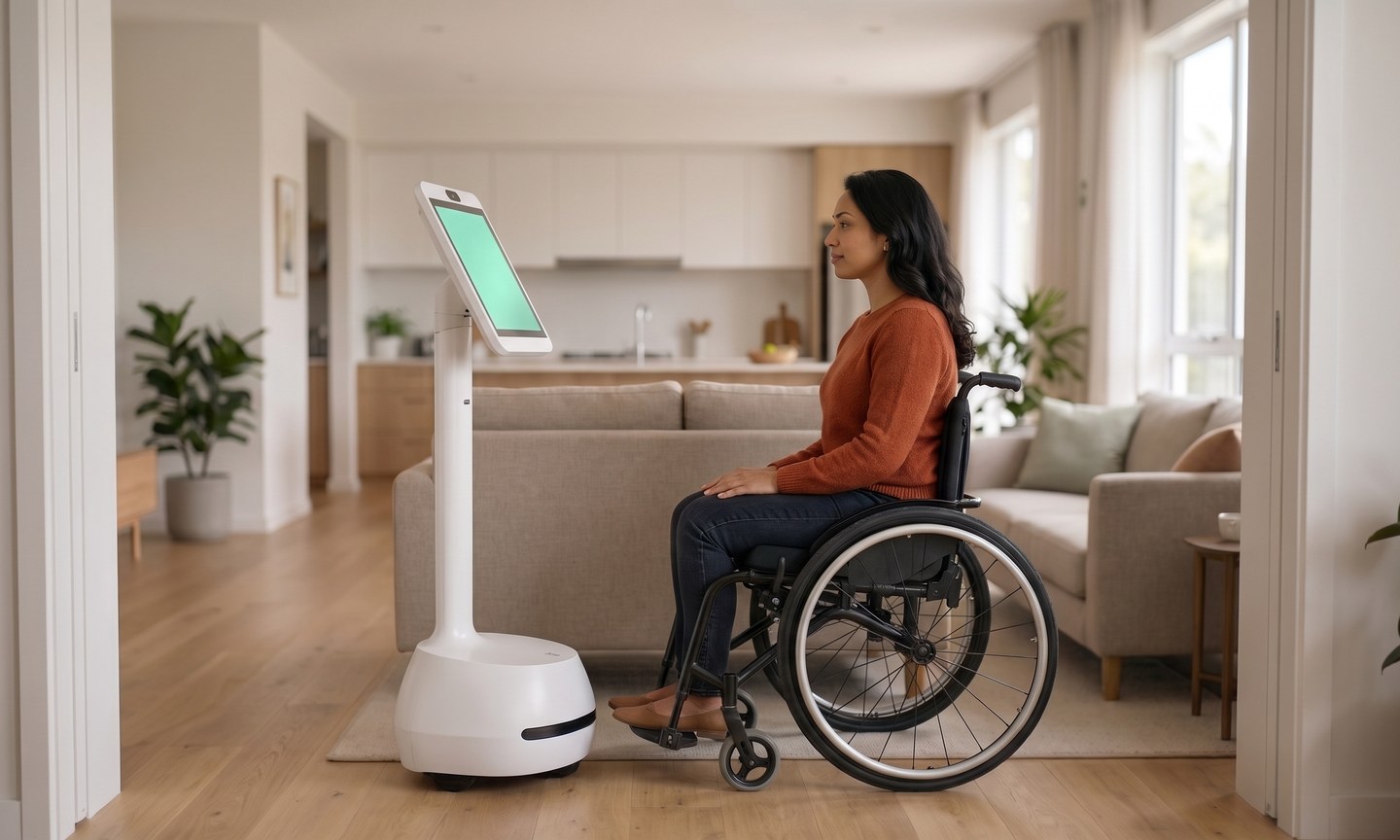
Regular check-ups catch health changes early, but getting to a clinic is hard for many people living with a disability. An AI robot brings the check-up to them, adapts to how each person communicates, and does it the same way every week.
More than 1 in 4 adults in the US live with a disability.¹ Many of them face a higher risk of long-term conditions: adults with disabilities are more than twice as likely to have diabetes (16.7% compared with 7.4%).²
Yet regular check-ups are often the hardest part of care to keep up. A clinic visit can mean booking accessible transport, arranging support and a long wait, and people with disabilities are more likely to skip needed care because of transport.³ Phone health apps don’t solve it either: they need steady hands to hold the camera and good hearing to follow audio prompts.
FaceEcho brings the check-up to the resident. Using guided face scans, short video and a few symptom questions, it screens for signs of 30+ health issues at once. When a robot captures those scans, every check-in is consistent, and the resident does not have to go anywhere.
Quick Answer
Disability residences and supported-living homes can use an AI robot to give every resident a regular health check-up. The robot comes to the resident, shows every question in large, clear text and reads it aloud, and the resident answers by voice, by tapping, or by typing on the screen. Speaking is never required. The robot captures guided face scans with the same distance, light and angles every time, even from a wheelchair. FaceEcho screens the results for signs of 30+ health issues, including early signs linked to diabetes and heart health, and shares them with the resident, their family and their support worker. The robot supports care teams; it does not diagnose or replace them.
Key Benefits for Disability Care Providers
- Early detection: Early signs linked to diabetes and heart health are caught before they turn into emergencies.
- Accurate detection: Same distance, same light, every week, so FaceEcho spots real trends, not noise.
- Quick, easy and low-cost: A weekly health check-up in minutes, for a fraction of the cost of a clinic visit, with no transport, no appointment and no waiting room.
- Accessible by design: Large on-screen text and typing for hearing loss, voice for low vision and limited hand use, and a Skip button for anyone who prefers not to speak.
- Everyone stays informed: Results go to the resident, their family and their support worker after every check-in.
Why Regular Check-Ups Matter for People With Disabilities
Many health problems begin with small, gradual changes: more thirst than usual, tiredness, dry skin, or a change in sleep. On their own they are easy to miss, especially when a check-up depends on travel and planning.
- Higher risk of long-term conditions. Adults with disabilities are more likely to have diabetes, heart disease and obesity than adults without disabilities.¹ ²
- Harder access to care. Around 1 in 4 to 1 in 5 adults with disabilities report an unmet need for health care,¹ and transport is a common reason care is skipped.³
A check-up that comes to the resident, every week, removes the biggest barrier.
How AI Can Now Detect Signs of Multiple Conditions
The face carries many health signals: skin color and tone, puffiness, eye appearance, lips and teeth, and even the pulse visible in the skin. Research shows that AI can learn to read them. One deep learning model, for example, detected coronary artery disease from facial photos with 80% sensitivity in more than 5,700 patients.⁴ Results like this depend on good, comparable images, and that is where a robot helps most.
Why a Robot Makes the Check-Up Accessible
- Nothing to hold: The robot moves its camera, not the person. Residents stay in their chair or wheelchair.
- Every question on screen: Large, clear text for anyone with hearing loss, and every question read aloud for anyone with low vision.
- Answer your way: Say it, tap it, or type it. Speaking is never required.
- Consistent scans: The same distance, light and angles every week, so changes reflect the resident, not the camera.
- Every resident, every week: Scheduled visits make sure check-ups actually happen.
A Resident Example
Consider Maya, a fictional resident in a supported-living home who uses a wheelchair. Each week the robot greets her by name, shows each question on its screen and reads it aloud, and Maya answers by voice or with a tap. It guides her through a short series of face scans while she stays in her chair, then asks if she would like to read a short line aloud, or tap Skip.
Maya sees her results and simple skin tips on the robot’s screen, and her family and support worker receive a summary. When her answers about thirst and a change in her skin appear over two weeks, her support worker knows to arrange a follow-up. FaceEcho does not decide what is wrong. It makes sure the change is seen early.
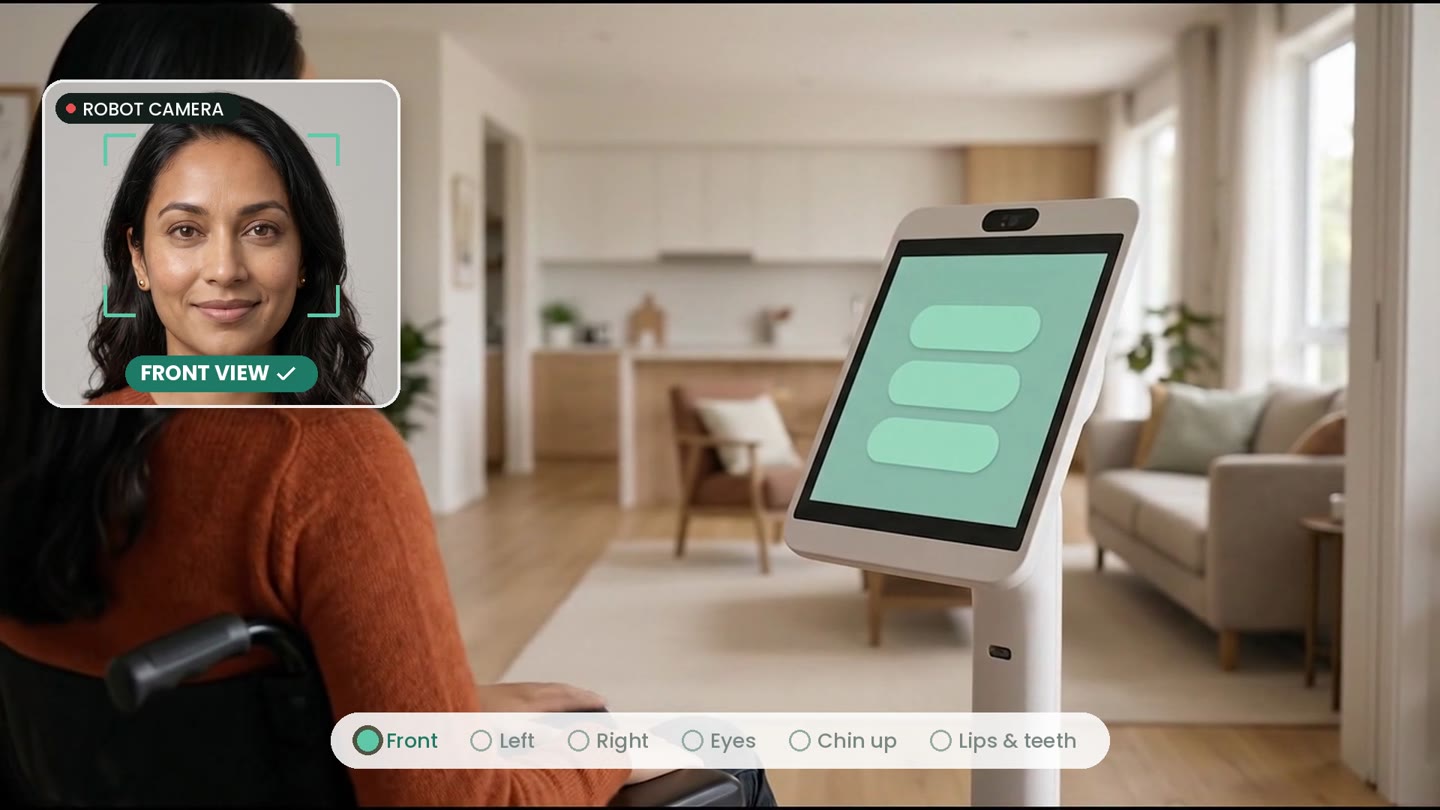
How Does a FaceEcho Robot Check-In Work
- The robot arrives at the resident’s room or shared space on a set schedule.
- Questions on screen about tiredness, thirst, sleep and vision, answered by voice, tap or typing.
- Guided face scans from the front, sides, eyes, and chin up with lips and teeth. The robot adjusts, not the person.
- AI screening for signs of 30+ health issues, compared with earlier check-ins.
- Results shared with the resident, their family and their support worker.
Safety and Clinical Boundaries
FaceEcho surfaces visible patterns from guided face scans and symptom answers. It does not diagnose, treat or replace medical advice, and the robot does not replace doctors, nurses or support staff. Medical decisions always rest with qualified professionals.
How Can a Disability Care Provider Start
Most providers start with a focused pilot: a small group of residents, weekly robot check-ins for a set period, and a review of completion rates, staff time and how flagged changes were followed up.
Explore FaceEcho Robots for Accessible Care
Final Takeaway
An AI robot brings a regular health check-up to every resident, adapts to how each person communicates, and captures it the same way every week, so early signs are caught and everyone who cares for the resident stays informed.
Frequently Asked Questions
What if a resident cannot hear the robot?
Every question appears on the screen in large, clear text, and the resident can answer by tapping or typing.
What if a resident prefers not to speak?
Speaking is never required. Residents can tap or type their answers, and the read-aloud step has a Skip button. The face scan is all FaceEcho needs.
Does the resident need to move or hold anything?
No. The resident stays in their chair or wheelchair, and the robot adjusts its camera for each scan.
Who sees the results?
The resident sees a summary on the robot’s screen, and their family and support worker receive the results after every check-in.
Does the robot replace doctors, nurses or support staff?
No. The robot runs a consistent check-up. Medical decisions always rest with qualified professionals.
References
- Centers for Disease Control and Prevention. Disability Impacts All of Us. Disability and Health Data System.
- Centers for Disease Control and Prevention. Disability and Health Data Now. Behavioral Risk Factor Surveillance System, 2018.
- Urban Institute for the Robert Wood Johnson Foundation. Health Reform Monitoring Survey, June 2022, reported in Axios, April 2023.
- Lin S, Li Z, Fu B, et al. Feasibility of using deep learning to detect coronary artery disease based on facial photo. European Heart Journal. 2020.