Context
Clinicians receive relevant patient-provided information before the consultation begins, providing a concrete baseline for the encounter.

A pre-consult layer is the preparation patients complete before a telehealth appointment: organising symptoms, medical history, medications and relevant visual information so they can discuss them with a clinician. Guided facial capture can be explored as an additional source of visual context. It does not establish a diagnosis or determine which tests a patient needs.
For telehealth providers, the practical question is how to help patients arrive with useful information, and how to make that information available through an agreed sharing process. FaceEchos potential role is in patient preparation; any clinical or workflow benefit needs evaluation.
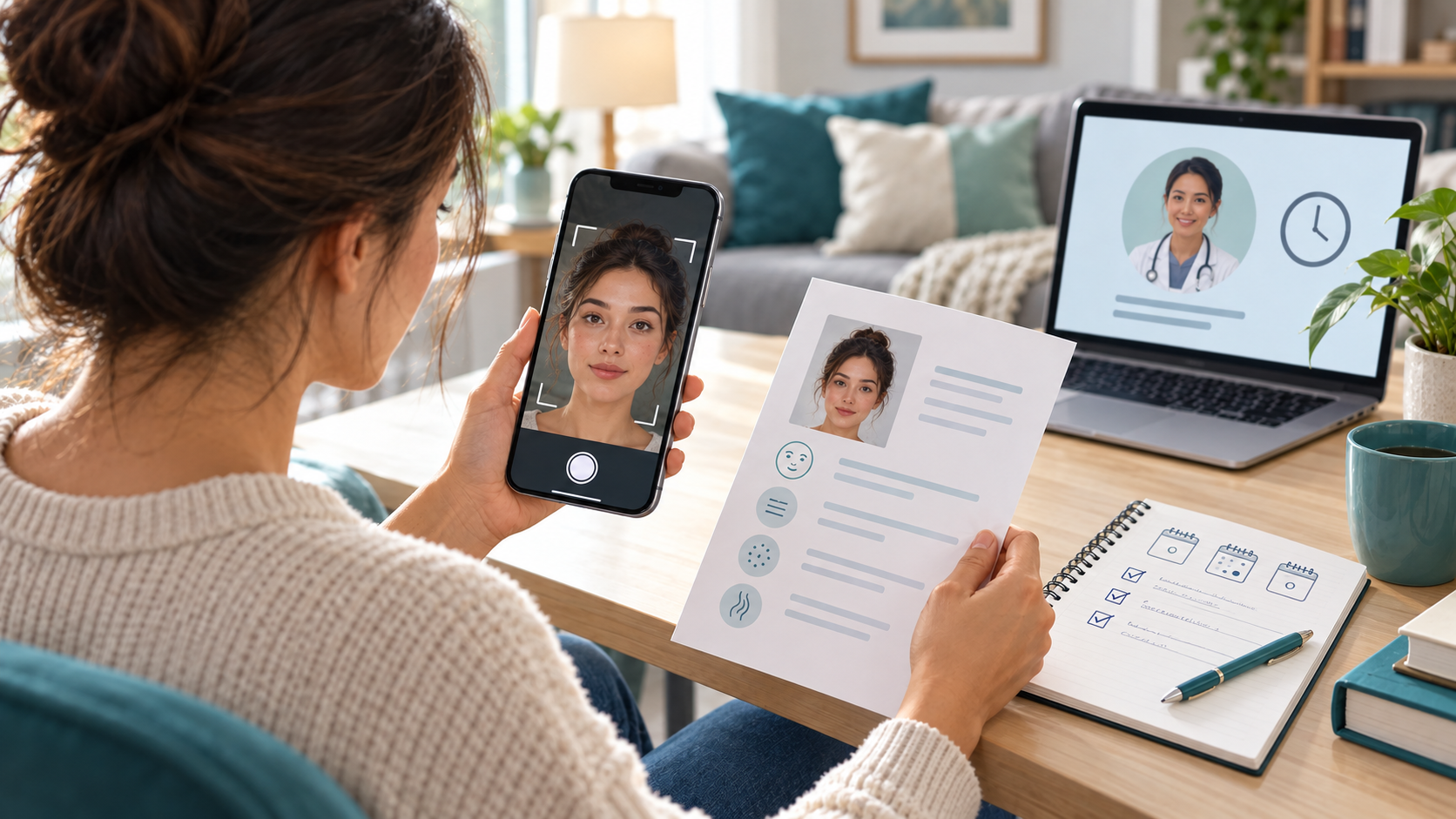
Illustrative cover image • Non-diagnostic telehealth pre-consultation workflow
Preparation Architecture
Healthcare consultations can begin with patients trying to recall when symptoms started, what has changed and which medicines they take. Collecting that information beforehand can give the conversation a clearer starting point.
Clinicians receive relevant patient-provided information before the consultation begins, providing a concrete baseline for the encounter.
Where appropriate, that information can help care teams determine the next step, whether that means a further assessment, a test or a specialist appointment.
Information collected over time can provide a reference point for subsequent consultations and follow-ups across the care continuum.
The Limitation of Text Intake Forms: Intake forms already attempt to address some of this. But forms rely on patients describing their experiences in words. “I have been feeling tired” could mean poor sleep, a stressful week or an issue that warrants further clinical assessment.
The challenge is not simply collecting more information. It is collecting useful information in a consistent, accessible format that complements the clinical conversation.
Clinical Context
The face is one of the first things a clinician sees, whether in person or on a video call. Visible changes can sometimes provide useful context for further questions and clinical assessment.
Patients often observe changes in under-eye appearance, shadowing, or tiredness that prompt them to seek clinical guidance.
Visible fluid distribution or changes in facial fullness can provide relevant background when discussed alongside a symptom timeline.
Surface changes in redness, tone, or texture may prompt valuable questions for the clinician during an initial or follow-up consult.
No Standalone Diagnosis: None of these observations establishes a diagnosis on its own. Lighting, camera quality, skin tone, individual differences and other factors can all affect what is visible. These are examples of visible concerns a patient may describe, rather than a claim that FaceEcho measures every feature or establishes its cause.
The Questions They Prompt: Their potential value lies in the questions they prompt. Could a clinician benefit from additional context? Is further assessment warranted? Has something visibly changed since the last consultation? These observations are not new to medicine. The opportunity is to explore whether guided, consistent visual capture can make relevant information easier to organise and review before a patient meets a clinician.
Technology & Settings
FaceEcho.ai is exploring how guided facial scanning can contribute to a more structured patient-preparation experience.
Before an appointment, a patient can complete a guided facial scan using their phone. FaceEcho uses AI-assisted facial analysis to present observations from a guided scan in a report the user can review. The user manually shares the report with a clinician using a method the provider accepts. This workflow does not assume automatic provider access or an existing integration.
The broader opportunity is to make visual information easier to collect consistently and review alongside a patients history, symptoms and other relevant clinical information.
A structured pre-consultation process could give patients a way to prepare relevant information before a video appointment. It could also provide an additional touchpoint for patient engagement between consultations.
Visual information, combined with appropriate symptom history and clinical guidance, could be explored as part of a patient-preparation workflow. Any test recommendations would still need to follow validated clinical protocols and professional judgment.
Guided scans could be evaluated as part of the patient journey, from appointment preparation to follow-up. Over time, appropriately collected information may help care teams explore changes between visits.
Clinical Simulation
Imagine two patients booking the same 10 a.m. teleconsultation for fatigue.
Patient A joins the call without any information prepared. The clinician begins by taking a history, asking follow-up questions and helping the patient position their phone so they can be seen clearly.
Further assessment is considered based on the consultation, with significant consultation time spent establishing basic facts and environmental lighting.
Patient B completes a guided facial scan before the appointment and prepares a symptom history. The patient manually shares the report through a method their provider accepts.
If the clinician receives it before the consultation, they can review it alongside the patients symptoms and medical history, using it as an additional source of context rather than as a diagnosis.
Organised Information, Not Automated Diagnosis: The difference is not that the second patient has been diagnosed by a camera. It is that the consultation may begin with more organised information.
This is a potential workflow benefit, not a proven outcome. Whether it saves time, improves decision-making or changes testing patterns must be evaluated in practice.
Clinical Boundaries & Rigour
Healthcare needs a clear distinction between useful information and validated clinical evidence.
A facial scan does not replace a physical examination, laboratory testing, a medical history or a clinicians judgment. Visible features alone cannot reliably establish the cause of a symptom such as fatigue.
AI-generated observations are subject to camera, lighting and model limitations. They should not be treated as definitive clinical findings. This article does not establish diagnostic accuracy, disease detection or an ability to measure internal health from a photograph.
The purpose of a pre-consult layer is to explore how information can be collected, organised and presented before an appointment — helping clinicians decide what, if anything, needs further investigation. The clinician remains responsible for clinical interpretation and decisions.
Frequently Asked Questions
Practical guidance on patient preparation, report sharing, and system boundaries.
Prepare a symptom timeline, current medicines and supplements, relevant test results, medical history and the main questions you want to ask. For a visible concern, dated photographs may help you describe what changed. Follow the providers preparation instructions and use its accepted sharing method.
Guided capture provides visual information to discuss alongside the patients account. For example, a patient concerned about facial puffiness can describe when they noticed it and any other symptoms. An image alone does not explain the cause or show which test or treatment is appropriate.
The patient manually shares the report using a method their clinician accepts. Patients should check the providers instructions before sending personal health information. This proposed workflow does not require or imply an existing FaceEcho integration, automatic clinician access or automatic transfer into a medical record.
FaceEcho observations do not establish a diagnosis, determine the cause of symptoms or replace a clinical history, examination, laboratory test or professional judgment. A clinician decides whether further assessment is needed. Patients with urgent concerns should seek appropriate care rather than wait to complete a scan or a scheduled appointment.
Evidence-Based Pilot
The value of a new healthcare workflow should be demonstrated in practice, not assumed. FaceEcho welcomes conversations with healthcare organisations interested in evaluating guided facial scanning as part of patient preparation and engagement.
Whether clinicians find the available information useful before an appointment.
Whether the process affects preparation time or information-gathering workflows.
Whether patients complete the process and find it useful.
Whether the information adds meaningful context when reviewed alongside standard clinical assessment.
Visit FaceEcho.ai to learn more, or contact the FaceEcho team through the website to discuss a potential collaboration and agree on suitable next steps.
Telehealth expanded access to clinicians. The next opportunity is to make the time before a consultation more useful, with better-prepared patients and information that supports — rather than replaces — clinical judgment.
The consultation may happen on a screen. The preparation for it can start much earlier.