
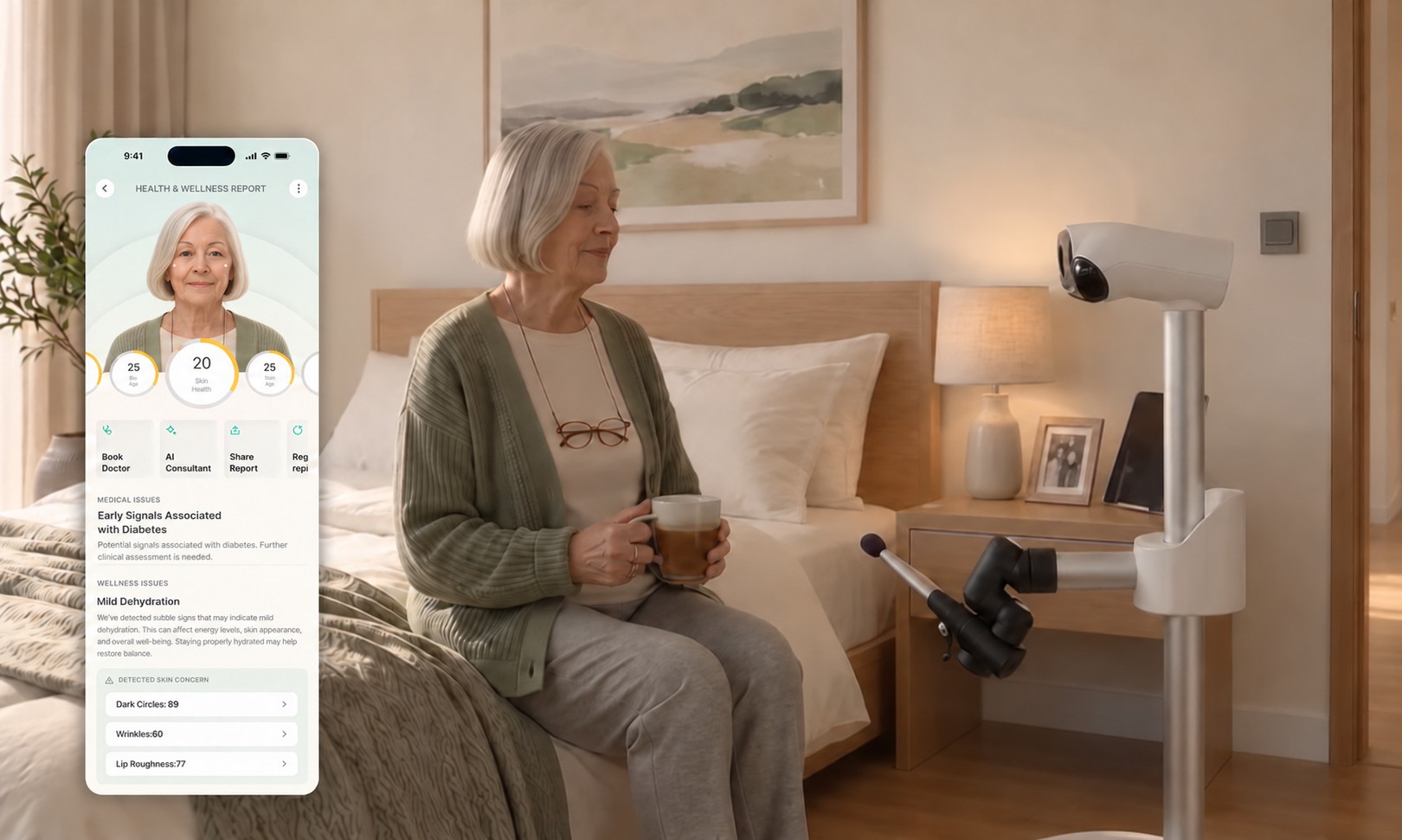
Regular check-ups catch health changes early. AI can now spot signs of many conditions from a face scan. A robot makes that check-up consistent, brings it to every resident, and gives them a reason to look forward to it.
Health changes in older adults often build slowly. Tiredness, dehydration or swelling can develop over days or weeks before anyone notices, and by then a resident may need urgent care.
Spotting these changes early makes a real difference. In nursing homes, programs that help staff identify a change in a resident’s condition early have reduced hospitalizations by 17%.¹ Yet many changes are hard to see: in one UK study, 1 in 5 care home residents was dehydrated, and common signs and symptoms did not reliably detect it.² ³
AI now makes regular check-ups practical. Using a series of face scans, short video and a few important symptom questions, FaceEcho screens for signs of 30+ health issues at once. When an assistive robot captures those scans, every check-in is consistent, and the resident does not have to go anywhere.
Quick Answer
Senior care facilities can use an AI robot to give every resident a regular health check-up. The robot comes to the resident, asks a few symptom questions and captures guided face scans with the same distance, light and angles every time. FaceEcho screens the results for signs of 30+ health issues and alerts the care team only when something meaningful changes. Mirror, skincare and makeup insights keep residents engaged week after week. The robot supports nurses and doctors; it does not diagnose or replace them.
Key Benefits for Senior Care Facilities
- Early detection: Regular check-ins help the care team catch changes before they become emergencies.
- Accurate detection: Same distance, same light and same angles every time, so changes are real, not noise.
- Quick, easy and low-cost: A weekly health check-up in minutes, for a fraction of the cost of a clinic visit.
- No need to move: The robot comes to the resident’s room. Residents stay seated and follow simple voice prompts.
- Something to look forward to: Mirror, skincare and makeup insights give residents a personal reason to take part every week.
Why Do Seniors Need Regular Health Check-Ups
Many health problems in older adults begin with small, gradual changes that are easy to miss on their own. Studies in long-term care show why catching them early matters:
- Fewer hospital visits. The INTERACT II program trained nursing home staff to identify and act on changes in a resident’s condition early. Across 25 nursing homes, hospitalizations fell by 17% over six months.¹
- Hidden problems are common. In the UK DRIE study of 188 care home residents, 20% were dehydrated, and commonly used signs and symptoms did not reliably identify it.² ³
How AI Can Now Detect Signs of Multiple Conditions
The face carries many health signals: skin color and tone, puffiness, eye appearance, lips and teeth, and even the pulse visible in the skin. Research shows that AI can learn to read them:
- Heart disease: A deep learning model analyzing four facial photos detected coronary artery disease with 80% sensitivity in more than 5,700 patients.⁴
- Genetic conditions: DeepGestalt listed the correct syndrome among its top 10 suggestions 91% of the time across 216 genetic syndromes.⁵
- Overall health: FaceAge estimated biological age from a face photo, and an older FaceAge was linked to worse survival in people with cancer.⁶
- Vital signs from video: Short face videos can estimate heart rate from tiny color changes in the skin.⁷
AI works best with more than one input. A series of scans from different angles, a short video and a few symptom questions together give a much fuller picture than any single photo. But results also depend on how images are captured; heart-rate estimates from face video, for example, change with lighting.⁷ This is where a robot helps most.
Why a Robot Makes AI Health Check-Ups Work
- Consistent scans: The same distance, light and angles for every resident and every check-in, so week-to-week changes reflect the resident, not the camera.
- The senior does not have to move: The robot comes to the room. There is nothing to hold and nowhere to go.
- Every resident, every week: Scheduled rounds make sure check-ups actually happen, not only for those who ask.
- More time for care: Nurses are alerted only when something meaningful changes.
Why Beauty Keeps Residents Engaged
A weekly check-up only works if residents want to take part. Looking good matters at every age: in a 2026 survey of 1,000 adults aged 65 and over, 53% said they feel prouder of their appearance when they keep up their grooming, and 44% said it makes them feel more like themselves.⁸
FaceEcho turns that into a reason to look forward to the robot’s visit:
- Mirror Check: A quick look-ready check of hair, shine, teeth and lips, with a gentle note on anything worth watching.
- Skincare: Personal insights on hydration, tone and glow, with simple daily tips.
- Makeup: For those who enjoy it, a personal makeup look matched to their skin tone, and a review of the finished look.
The resident gets something they enjoy every week, and the care team gets the consistent health check-in they need from the same visit.
A Resident Example
Consider Evelyn, a fictional resident in an assisted-living community. Each Monday morning, the robot greets her by name, asks whether she has felt tired, unusually thirsty or had blurry vision, and guides her through a short series of face scans while she stays seated.
Evelyn enjoys her Mirror Check and skincare tips on the robot’s screen, and her care coordinator receives a report. When a pattern linked to her answers about thirst appears over two weeks, her nurse is alerted to follow up. FaceEcho does not decide what is wrong. It makes sure the change is seen early.
How Does a FaceEcho Robot Check-In Work
- The robot arrives at the resident’s room on a set schedule.
- Symptom questions about tiredness, thirst, sleep and vision.
- Guided face scans from the front, sides, eyes, and chin up with lips and teeth, all at the same distance and light.
- AI screening for signs of 30+ health issues, compared with earlier check-ins.
- Results and alerts. The resident sees a summary with mirror, skincare and makeup tips; the coordinator gets a report; a nurse is alerted only on meaningful change.
Safety and Clinical Boundaries
FaceEcho surfaces visible patterns from guided face scans and symptom answers. It does not diagnose, treat or replace medical advice, and the robot does not replace doctors or nurses. The research above describes what AI can do in studies; FaceEcho results are screening signals for the care team to review.
How Can a Senior Care Facility Start
Most facilities start with a focused pilot: a group of residents or a single wing, weekly robot check-ins for a defined period, and a review of completion, staff time and how flagged changes were handled.
Explore FaceEcho Robots for Senior Care
Final Takeaway
An AI robot brings regular health check-ups to every resident, captures them the same way every time, and makes them something residents enjoy, so nurses can focus on the changes that matter.
Frequently Asked Questions
Why do senior care residents need regular health check-ups?
Health changes in older adults often build slowly and are easy to miss. Identifying them early can reduce hospitalizations, and some common problems, such as dehydration, are hard to spot from signs and symptoms alone.
How can AI detect health issues from a face scan?
The face shows signals such as skin tone, puffiness, eye appearance and pulse-related color changes. AI trained on large image sets can recognize patterns linked to different conditions, especially when scans, video and symptom questions are used together.
Why is a robot better for these check-ups?
It captures every scan at the same distance, light and angles, so changes reflect the resident rather than the set-up. It also comes to the resident, so seniors do not need to move.
Why does FaceEcho include beauty features?
Mirror, skincare and makeup insights give residents a personal reason to enjoy the weekly visit, which keeps check-ins regular.
What happens when the robot flags a change?
The care team receives an alert with the scans, the resident’s answers and their recent trend. A nurse reviews it and decides whether to follow up.
Does the robot replace nurses or doctors?
No. The robot runs a consistent check-up. Medical decisions always rest with qualified professionals.
References
- Ouslander JG, Lamb G, Tappen R, et al. An evaluation of the INTERACT II collaborative quality improvement project aimed at reducing hospitalizations from nursing homes. Journal of the American Geriatrics Society. 2011;59(4):745–753.
- Hooper L, Bunn DK, Downing A, et al. Which frail older people are dehydrated? The UK DRIE study. The Journals of Gerontology: Series A. 2016;71(10):1341–1347.
- Bunn DK, Hooper L. Signs and symptoms of low-intake dehydration do not work in older care home residents — DRIE diagnostic accuracy study. Journal of the American Medical Directors Association. 2019.
- Lin S, Li Z, Fu B, et al. Feasibility of using deep learning to detect coronary artery disease based on facial photo. European Heart Journal. 2020.
- Gurovich Y, Hanani Y, Bar O, et al. Identifying facial phenotypes of genetic disorders using deep learning. Nature Medicine. 2019;25:60–64.
- Bontempi D, et al. FaceAge, a deep learning system to estimate biological age from face photographs to improve prognostication. The Lancet Digital Health. 2025.
- Yang Z, Wang H, Lu F. Assessment of deep learning-based heart rate estimation using remote photoplethysmography under different illuminations. arXiv:2107.13193. 2021.
- Talker Research for Home Instead. How self-care makes a difference for Americans 65+. June 2026.